
Blog · Pay & laws
Connecticut Final Paycheck Law (2026): Due the Next Business Day
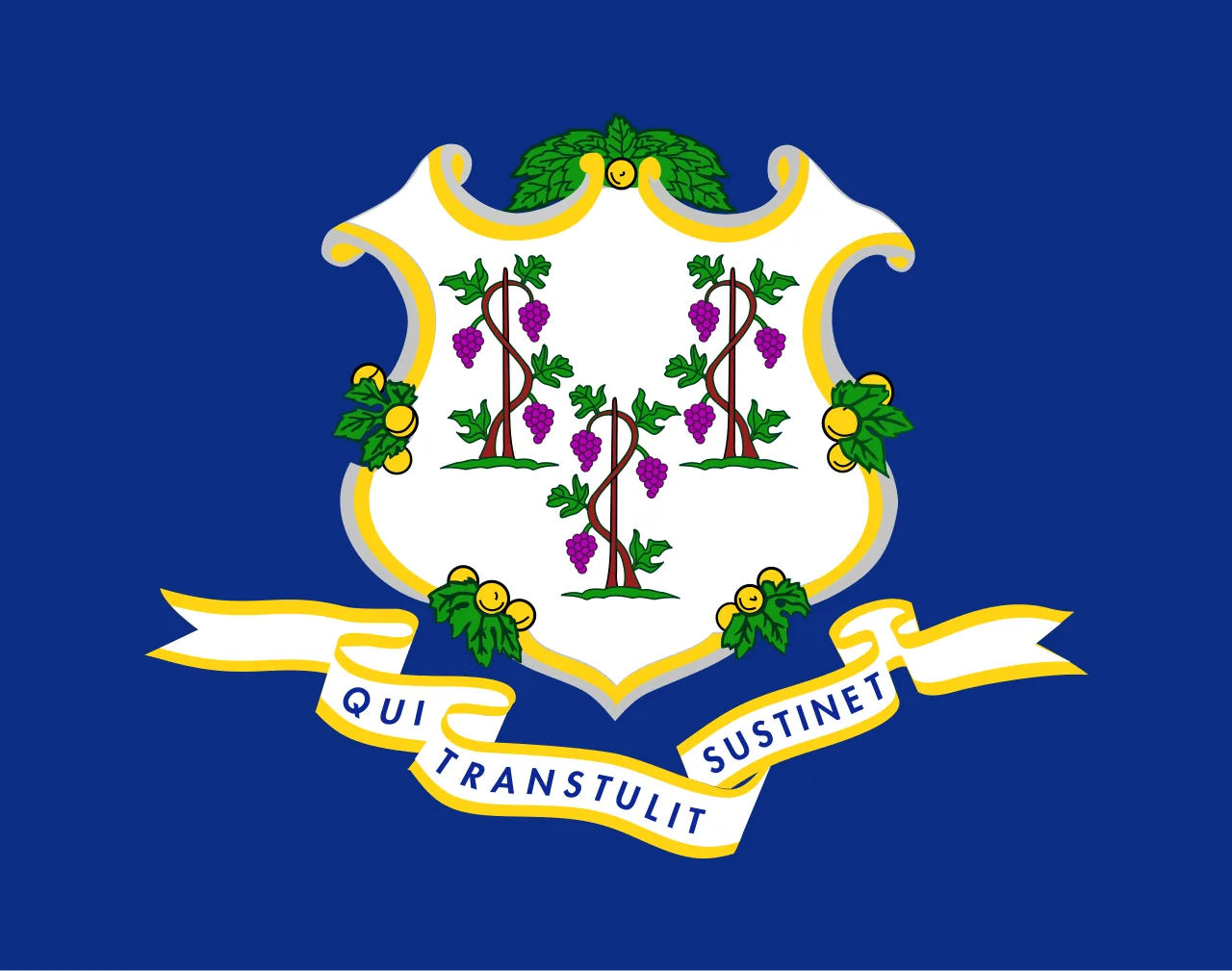
The Connecticut state flag. Image: Wikimedia Commons, public domain.
The short answer
- You fire someone: Under Connecticut final paycheck law, wages are due in full by the next business day after the firing.
- They quit, or you lay them off: Wages are due by the next regular payday.
- If you're late: An employee can sue for twice the unpaid amount, plus court costs and attorney's fees.
- Unused vacation: Owed if your policy says it's paid out at termination.
- Paperwork at the door: The state's unemployment separation packet, handed over at separation or mailed.
Connecticut gives you one business day after a firing. Your payroll provider's normal cycle won't make that, so arrange the check before the conversation, not after.
For the 50-state view, see Final paycheck laws by state. This post covers Connecticut only.
On this page
- When is the final paycheck due in Connecticut?
- What does a late final paycheck cost?
- Do you have to pay out unused vacation?
- What can you take out of the last check?
- What paperwork do you hand over?
- What about health insurance after a firing?
- Your Connecticut firing checklist
- Questions owners ask
When is the final paycheck due in Connecticut?
Connecticut treats a firing and a layoff differently.
| How the job ended | When wages are due |
|---|---|
| You fire the employee | By the business day after the firing |
| The employee quits | Next regular payday, through the usual channels or by mail |
| You lay the employee off | Next regular payday |
| Work is suspended by a labor dispute | Next regular payday |
Two details worth knowing:
- "Wages" is broad. It means pay for labor or services, whether figured by time, task, piece, commission or another method.
- Fired on a Friday. The law says the next business day but doesn't define "business day." Monday is the natural reading. The safe plan is to have the check ready at the meeting.
If you and the employee disagree on the amount, pay the part you agree you owe, promptly and with no strings attached. Accepting it doesn't waive the employee's claim to the rest. If you require a signed release before you'll pay, that release is void.
What does a late final paycheck cost?
Double, by default.
- The lawsuit. An employee can sue for twice the full amount of unpaid wages, plus costs and reasonable attorney's fees.
- The good-faith limit. If you prove you believed in good faith that the underpayment complied with the law, recovery drops to the unpaid amount, plus costs and fees. Proving it is your job.
- The state can collect too. The Labor Commissioner may collect unpaid wages with interest, and may sue for twice the amount.
- Civil penalty. $300 per violation, assessed for each affected employee.
- Criminal penalties. Fines and possible jail time scale with the amount owed to one employee. They start at a $200 to $500 fine for $500 or less. Over $2,000 is a Class D felony.
Double damages also apply to unpaid vacation and other accrued benefits your policy promised.
Do you have to pay out unused vacation?
If your policy says so, yes.
Connecticut's rule covers accrued fringe benefits: paid vacation, holidays, sick days and earned leave. If your policy or a union contract says they're paid at termination, and the employee leaves without getting them, you owe them.
- Follow the policy. Payment follows the policy's terms.
- There's a floor on the rate. Never less than the employee's earned average rate for the accrual period.
- Your policy has to be in writing somewhere. Employers must make available, in writing or by posted notice, their policies on wages, vacation pay, sick leave and similar matters.
So the question is what your handbook promised. Read it before the meeting. The law says these benefits are paid as wages under your policy, but it doesn't set a separate deadline for them. The safe plan is to put them on the final check, inside the next-business-day window.
Small-business HR news, in plain words
New laws, pay rules and people problems that hit your business and your bottom line, explained in plain words. One short email when it matters.
It's free. Enter your email on the next page and you're on the list. We'll send it to your inbox. Unsubscribe any time.
What can you take out of the last check?
Very little without paperwork.
You may withhold from wages only when:
- State or federal law requires or permits it (taxes, garnishments).
- The employee gave written authorization on a form approved by the Labor Commissioner.
- The employee authorized, in writing, deductions for medical, surgical or hospital care, with no financial benefit to you.
- The deductions are automatic-enrollment retirement contributions.
- Another state requires income tax withholding.
Unreturned tools, a damaged truck or a cash shortage aren't on that list. A line in your handbook isn't a commissioner-approved form.
What if they don't return company property?
Collect what you can at the meeting. For anything that's still out, here's what I tell owners:
- Pay final wages on time. Don't use the paycheck as leverage, and don't withhold legally owed wages.
- Document what's missing and send a written request with a reasonable return deadline.
- Keep a record of every attempt to get it back. If it still isn't returned, talk to an employment attorney about your civil options. Suspected theft may warrant a police report.
What paperwork do you hand over?
The unemployment separation packet.
- Who gets it: every separating employee, whatever the reason. That includes someone who quits.
- When: at the time of separation.
- If you can't hand it over: mail it to the employee's last known address.
- What you fill out: the Unemployment Notice. It asks for employer and employee details, start date, last day worked, year-to-date earnings, the reason for unemployment (lack of work, voluntary leaving, discharge or suspension, leave of absence, other), any dismissal pay, and your signature.
- Don't send a copy to the Department of Labor.
A note on form numbers. You'll see this called the "UC-61" all over the internet. The packet on the Department's site when we checked is the UC-21 (Rev. May 2025), and the employer's notice inside it is the UC-21A (Rev. March 2025). Download a fresh copy each time.
After the claim is filed, the Department asks you for information, and the employee may be scheduled for a fact-finding hearing. Check the box on the Unemployment Notice honestly, and answer every Department request by its deadline.
What about health insurance after a firing?
There are two pieces here, and one of them has a 72-hour clock.
Continuation coverage
- Which plans: federal COBRA covers employers with 20 or more employees. Connecticut state continuation protects employees of fully insured Connecticut groups with fewer than 20.
- How long: up to 30 months after a layoff, reduction of hours, leave of absence or termination of employment. That 30-month maximum applies to fully insured Connecticut plans of any size.
- Not for gross misconduct. An employee terminated for gross misconduct can't elect continuation.
- Notices: the Insurance Department publishes a General Notice and an Election Notice for Connecticut continuation. Its page doesn't say who sends the election notice, when it's due, or the premium cap. Get those answers from your carrier before the last day.
Ending coverage at termination
Connecticut lets you choose to stop paying group health premiums when you fire an employee or the employee resigns. That choice isn't available for layoffs, or when a covered location relocates or closes.
If you make that choice, you have two jobs within 72 hours of the termination:
- Notify the insurer, with the employee's name, termination date and whether dependents were covered.
- Notify the employee that coverage is ending. The Insurance Department strongly recommends doing it in writing at the time of termination.
With both notices done, coverage ends 3 calendar days after the termination, and the employee can then elect continuation. The Department's bulletin dates from 2009, but the current statute keeps the same 72-hour notice rule, and the insurer keeps the premium for those 72 hours. Ask your carrier how it wants the notice sent.
Your Connecticut firing checklist
- Settle the reason in one sentence. See when to fire an employee. It goes on the Unemployment Notice.
- Order an off-cycle check before the meeting. Wages and commissions through the last day.
- Read the vacation policy. Add what it promises.
- Don't deduct for property without a commissioner-approved authorization.
- Collect company property at the meeting. For anything still out, document what's missing, send a written request with a reasonable return deadline, and keep a record of your attempts to recover it. If it still isn't returned, consult an employment attorney about your civil options. Suspected theft may warrant a police report. Don't withhold legally owed wages.
- Print and complete the UC-21 separation packet. Hand it over at the meeting, or mail it.
- Pay in full by the next business day. Keep proof.
- Within 72 hours, if you're ending coverage: notify the insurer and the employee.
- Answer the Department's requests for separation information by their deadlines.
Questions owners ask
How long do I have to pay a fired employee in Connecticut?
Until the business day after the firing. Wages must be paid in full by then.
What if the employee quits?
Pay in full by the next regular payday, through the usual channels or by mail.
Is a layoff treated like a firing?
No. When you lay an employee off, wages are due by the next regular payday, not the next business day.
What's the penalty for a late final paycheck in Connecticut?
An employee can recover twice the unpaid amount, plus costs and attorney's fees. If you prove a good-faith belief that you complied with the law, recovery is limited to the unpaid amount plus costs and fees.
Do I have to pay out unused vacation in Connecticut?
Yes, if your policy or a union contract provides for payment of accrued vacation at termination.
Is the form called UC-61 or UC-21?
The separation packet currently posted by the Connecticut Department of Labor is the UC-21, with the Unemployment Notice (UC-21A) inside. Older references call it the UC-61.
This is general HR education from Square Deal HR, not legal advice. For your specific situation, talk to an employment attorney.
Want to learn more about your state's laws? See Final Paycheck Laws by State.
Sources
- Conn. Gen. Stat. § 31-71c, "Payment of wages on termination of employment." Connecticut General Assembly: https://www.cga.ct.gov/current/pub/chap_558.htm#sec_31-71c
- Connecticut Department of Labor, Wage & Workplace Standards Division, "Wage Payment Laws," DOL-74 (Rev. 12/23), summarizing Conn. Gen. Stat. §§ 31-69a through 31-76k: https://portal.ct.gov/dol/-/media/dol/2022-new-design-system/divisions/wage-and-workplace-standards/wagepaymentlaws_update12-2023.pdf
- Connecticut Department of Labor, "Wage and Hour": https://portal.ct.gov/dol/Divisions/Wage-and-Workplace-Standards/wage-and-hour
- Conn. Gen. Stat. § 31-72, "Civil action to collect wage claim, fringe benefit claim or arbitration award." Connecticut General Assembly: https://www.cga.ct.gov/current/pub/chap_558.htm
- Conn. Gen. Stat. § 31-76k, "Payment of fringe benefits upon termination of employment." Connecticut General Assembly: https://www.cga.ct.gov/current/pub/chap_558.htm
- Connecticut Department of Labor, Separation Packet UC-21 (Rev. May 2025), with Unemployment Notice UC-21A (Rev. March 2025): https://portal.ct.gov/dol/-/media/dol/2022-new-design-system/divisions/unemployment-insurance-benefits-division/separation-packet-uc21-may-2025.pdf
- Conn. Gen. Stat. § 38a-513e, employer premium payments after termination, as amended by Public Act 24-147, § 6. Connecticut General Assembly: https://www.cga.ct.gov/2024/ACT/PA/PDF/2024PA-00147-R00HB-05267-PA.PDF
- Connecticut Insurance Department, "Employee Rights to Continuation of Group Health Coverage": https://portal.ct.gov/cid/consumer-resource-library/health-insurance/cobra-connecticut-state-continuation-coverage
- Connecticut Insurance Department, Bulletin HC-73 (Public Act 09-126): https://portal.ct.gov/-/media/cid/bullhc73pdf.pdf
More for owners like you
Pay & laws
Final Paycheck Laws by State (2026)
When the last check is due, and what else you owe.

Firing
Before You Fire Someone: What to Think About First
Most bad firings go wrong months before the meeting.
Firing
When to Fire an Employee: What to Think About First
Most bad firings go wrong months before the meeting.
Small-business HR news, in plain words
New laws, pay rules and people problems that hit your business and your bottom line, explained in plain words. One short email when it matters.
It's free. Enter your email on the next page and you're on the list. We'll send it to your inbox. Unsubscribe any time.