
Blog · Pay & laws
Georgia Final Paycheck Law (2026): Payday and Form DOL-800
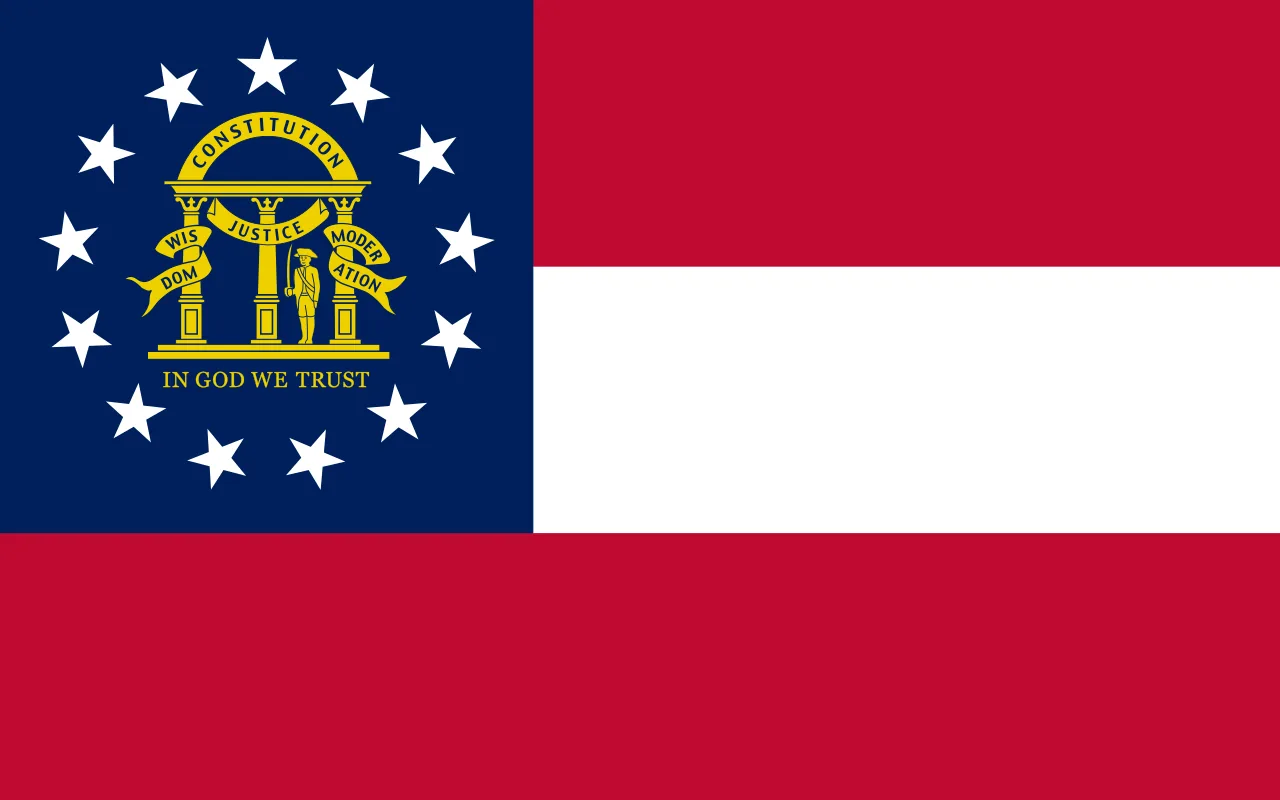
The Georgia state flag. Image: Wikimedia Commons, public domain.
General information from Square Deal HR, not legal advice. Check your situation with an employment attorney.
The short answer: Georgia final paycheck law
- Final paycheck: Georgia sets no special deadline. Pay everything earned on the regular payday for that pay period, whether they were fired or quit.
- Form DOL-800: The Separation Notice is due on the employee's last day of work. If they're not available that day, send it within 3 days.
- The reason: The form requires the reason for the separation, in complete detail for anything other than lack of work.
- Unused PTO: Your written policy decides.
- Health insurance: If your insured group plan is too small for federal COBRA (under 20 employees), Georgia's continuation law is the fallback: the rest of the policy month plus 3 more months, for employees covered at least 6 months, and not for someone terminated for cause.
The paycheck is the easy part in Georgia. The real work is a one-page state form and a benefits rule that changes depending on why the person left.
For the 50-state view, see the hub: Final Paycheck Laws by State. This post goes deeper on Georgia only.
On this page
- When is the final paycheck due in Georgia?
- Do you have to pay out unused PTO?
- What if they still have company property?
- What is Form DOL-800, and when is it due?
- What do you write as the reason?
- What happens if you skip the form?
- What about health insurance after a firing?
- Your last-day checklist for Georgia
- Questions owners ask
- Sources
When is the final paycheck due in Georgia?
On your regular payday. Georgia has no law that speeds up the last check, whether the employee was fired or quit.
What Georgia does have is a general payday rule:
- Pay at least twice a month. You pick the pay dates, split the month into at least two equal periods, and pay the full net wages due for each one. The U.S. Department of Labor's state payday table also lists Georgia as semi-monthly.
- Some workers are outside that rule. The law carves out certain industries and salaried managers. If you think yours is one, check the current code before relying on it.
- The law is silent on separation. It doesn't mention a final check at all.
Federal law doesn't fill the gap. It doesn't require an employer to hand over the final paycheck immediately.
Best practice: pay everything earned through the last day on the payday that covers that pay period.
If you miss that payday, the employee has two routes. The Georgia Department of Labor's FAQ sends unpaid-final-wage complaints to the U.S. Department of Labor's Wage and Hour Division, or to a wage claim in Magistrate Court (small claims) in the county where the employer is located. The FAQ doesn't point to any state wage-claim process for this.
Do you have to pay out unused PTO?
I found no Georgia law that requires an employer to pay out unused vacation or PTO at separation. The wage payment law doesn't address it.
That leaves your own written policy. Read it before the last day:
- If the handbook says unused PTO is paid out, pay it with the final check.
- If it says unused PTO is forfeited, follow it the same way for everyone.
- If it says nothing, decide now, write it down, and apply it the same way next time. Handling it one way for one employee and another way for the next is how you end up in Magistrate Court.
One paperwork detail: vacation pay and earned wages do not go in the "payments" box on Form DOL-800. The form's instructions exclude them.
What if they still have company property?
Don't use the last check as leverage. Here's what I recommend:
- Pay final wages on time. Don't use the paycheck as leverage, and don't withhold legally owed wages.
- Document what's missing and send a written request with a reasonable return deadline.
- Keep a record of every attempt to get it back. If it still isn't returned, talk to an employment attorney about your civil options. Suspected theft may warrant a police report.
What is Form DOL-800, and when is it due?
Form DOL-800 is Georgia's Separation Notice. It's a one-page state form that tells the employee, and the unemployment office if a claim is filed, when the job ended and why.
Who gets one: Every worker who leaves, whatever the reason. Fired, quit, laid off, retired.
When it's due:
- On the last day of work. Completed, signed, and dated.
- Within 3 days if the employee isn't available on the last day. The 3 days run from when the separation happened or when you learned of it. Send it by email, by another electronic method the employee uses, or by U.S. mail to the last known address.
How to deliver it. The rule was rewritten in 2026 and now encourages electronic delivery. Electronic delivery counts if:
- It goes to an email address, employee portal, or other system the employee uses for work communications.
- The method leaves a record you can keep and reproduce.
- The notice carries an electronic signature.
A signed paper copy handed to the employee still works.
Keep proof. If you deliver electronically, keep proof of delivery (a send log, system record, or read receipt) for at least 4 years.
The exception. If 25 or more workers at one location are separated on the same day for the same reason, and the separation is permanent, indefinite, or expected to last 7 days or more, you file a Mass Separation Notice (Forms DOL-402 and DOL-402A) with the Department within 48 hours instead of individual DOL-800s.
Use a fresh copy. The amended rule took effect August 9, 2026, and the Department announced the change to employers in October 2026. The form posted on the Department's site when we checked still showed revision R-02-24, so download a new copy each time in case it has been updated.
What do you write as the reason?
The real one, with detail. The form itself says Georgia law requires you to give the employee the notice "giving the reasons for separation."
Item 4 gives you two choices:
- 4a. Lack of work. Check the box. Nothing more needed.
- 4b. Anything else. Give complete details about the separation. Attach a sheet if you need more room.
How to write a 4b reason that holds up:
- State facts, not opinions. "No call, no show on March 3, 4 and 5 after a written warning on February 20" beats "bad attitude."
- Match your other paperwork. The reason on the DOL-800 should say the same thing as your termination letter and your write-ups. Three documents with three different reasons is a problem you made yourself.
- Don't soften it to be kind. Writing "lack of work" for someone you fired for misconduct is a false statement on a state form. The form prints the penalty: knowingly making a false statement to prevent or reduce benefits is a misdemeanor, with up to one year in jail, a fine of up to $1,000, or both.
Two things that should lower your blood pressure:
- It's privileged. Georgia law makes communications tied to the unemployment system absolutely privileged. They can't be the basis of a slander or libel suit in a Georgia court.
- It's an unemployment document only. The rule says the Separation Notice is not a record of employment or a service letter, and is not to be used as evidence of the reason for separation in any non-unemployment proceeding.
Item 5, payments: List severance, separation pay, or wages in lieu of notice, the period they cover past the last day, and the date paid. Leave out vacation pay and earned wages.
One more thing on the reason. Georgia's rules sit on top of federal laws like the FMLA, the ADA, and Title VII. Those apply to every firing, so make sure the reason holds up under them too.
Small-business HR news, in plain words
New laws, pay rules and people problems that hit your business and your bottom line, explained in plain words. One short email when it matters.
It's free. Enter your email on the next page and you're on the list. We'll send it to your inbox. Unsubscribe any time.
What happens if you skip the form?
The form is required by law. Here's exactly where the cost is if you miss one:
- You lose the option to stay quiet on a claim. When a former employee files for unemployment, the Department may send you a request for separation information (Form DOL-1199FF or DOL-403FF). If you already gave the employee a DOL-800, answering is optional. If you didn't, you must answer as instructed for your response to count as timely.
- A complete, on-time answer protects you. The Department won't take enforcement action over the missing notice if you answer that request completely and on time.
- Late or thin answers cost money. Fail to respond properly or on time on three separate claims in one calendar year, and your account is charged for benefits on every later claim paid that year. Those charges stand even if the decision is later reversed on appeal.
- An employee can't sue you to force one. The rule creates no private right of action to compel a Separation Notice.
Doing the DOL-800 on the last day takes ten minutes and puts your reason on the record while the facts are fresh. Skip it, and you're writing that reason weeks later, against a deadline, from memory.
What about health insurance after a firing?
The answer depends on your headcount, your plan, and the reason for the firing.
Which law applies?
- 20 or more employees: Federal COBRA generally covers your group health plan.
- Under 20 employees: Georgia's continuation law is the fallback. The law itself has no employer-size cutoff. Georgia's Insurance Commissioner describes it as the option for small group plans under 20 employees, and that's where it matters for you.
- Self-funded plans: Georgia's law is a state insurance law for insured group plans issued in Georgia. If your plan is self-funded, ask your administrator what applies.
What does Georgia continuation give the employee?
- How long: The rest of the policy month in which coverage ends, plus 3 more policy months. After that, the plan's conversion rights apply.
- Who qualifies: An employee continuously covered under the group plan for at least 6 months right before termination, along with their eligible dependents.
- What they pay: The same rate the plan charges active members, paid monthly in advance. The law doesn't require you to keep paying your share, so expect the employee to owe the full group rate. Unlike federal COBRA, there's no added admin fee.
- How and to whom they pay: By cash, certified check, or money order, to the policyholder or to the employer. You pick.
Who doesn't qualify?
Continuation is not available if:
- The employee was terminated for cause.
- Coverage ended because they didn't pay their share.
- The group coverage is immediately replaced by similar group coverage.
- The group plan was ended entirely, or for that employee's class.
That first exclusion matters in a firing. A layoff and a for-cause firing lead to different benefits letters.
Three gaps in the law. It doesn't define "for cause," it doesn't say who sends the continuation notice, and it sets no election deadline. Ask your carrier how it handles all three before the last day.
What about employees 60 or older?
A second Georgia law can extend coverage for employees who are 60 or older when their COBRA or state continuation begins.
It only applies to plans covering 20 or more employees. If you're under 20, you won't deal with it.
If you're at 20 or more:
- When it starts: After COBRA or state continuation runs out. Electing the first one counts as electing this one.
- How long: No fixed term. It ends at the earliest of a missed premium, the plan ending for everyone, the person enrolling in another group health plan, or the person becoming eligible for Medicare.
- What it costs them: No more than 120% of the group rate.
- Who's excluded: Among others, someone who quit for reasons other than health, and someone fired for reasons that would cost them unemployment benefits.
Have your carrier confirm the details before you put anything about it in a letter.
Your last-day checklist for Georgia
- Confirm the reason in one sentence. If you can't, you're not ready. See When to Fire an Employee.
- Download a fresh Form DOL-800 from the Georgia Department of Labor.
- Fill in Item 4 with facts and dates. Make it match the termination letter.
- Sign, date, and deliver it on the last day. Email, portal, or paper. Save proof of delivery for 4 years.
- If they're gone already, send it within 3 days.
- Check your PTO policy and pay what it promises.
- Run the final check on the regular payday for that pay period.
- Call your carrier about continuation. Give them the last day, tell them whether the firing was for cause, and ask who sends the continuation notice and what the employee (and any covered dependents) will owe.
- Set a written return deadline for any company property of substantial value.
- Calendar the deadline if a request for separation information arrives. Answer on time, every time.
Questions owners ask
Does Georgia require a final paycheck on the last day?
No. Georgia's wage law sets regular paydays at least twice a month and doesn't address separation. Federal law doesn't require immediate payment either. Pay on the regular payday for that pay period.
Is the deadline different if the employee quits?
No. Georgia law draws no line between quitting and firing for the last check. Form DOL-800 is required either way.
Do I have to give a DOL-800 to someone who quit?
Yes. The notice is required for each separated worker, whatever the reason.
Can I email the DOL-800?
Yes. The Department says electronic delivery is acceptable, and the rule encourages it. Send it to an address or system the employee uses for work, sign it electronically, and keep proof of delivery for at least 4 years.
Can the employee use the DOL-800 against me in a lawsuit?
The rule says the notice is not to be used as evidence of the reason for separation in any non-unemployment proceeding, and Georgia law makes unemployment-related communications privileged against slander and libel claims. That's not a promise about any case. Talk to an attorney if a lawsuit is on the table.
Does a fired employee get to keep health insurance in Georgia?
It depends on plan size and the reason. Under Georgia's continuation law, an employee covered on your insured group plan for at least 6 months can keep that coverage, plus covered dependents, for the rest of the policy month plus 3 more months, paying the active-member rate monthly in advance. It's not available to someone terminated for cause. Check with your carrier, since the law doesn't define cause or say who sends the notice.
Want to learn more about your state's laws? See Final Paycheck Laws by State.
Sources
- O.C.G.A. § 34-7-2, payment of wages. Official Code of Georgia, free public access: http://www.lexisnexis.com/hottopics/gacode/
- U.S. Department of Labor, "Last Paycheck": https://www.dol.gov/general/topic/wages/lastpaycheck
- Georgia Department of Labor, "Individuals FAQs - Laws and Regulations": https://dol.georgia.gov/node/2316
- O.C.G.A. § 34-8-190(c), separation notice. Official Code of Georgia, free public access: http://www.lexisnexis.com/hottopics/gacode/
- Ga. Comp. R. & Regs. 300-2-7-.06, "Separation Notices Required from Employers." Georgia Secretary of State: https://rules.sos.ga.gov/GAC/300-2-7
- Georgia Department of Labor, "Employers FAQs - Unemployment Insurance": https://dol.georgia.gov/node/2291
- Georgia Department of Labor, Form DOL-800, Separation Notice (R-02-24), including printed text of O.C.G.A. §§ 34-8-122(a) and 34-8-256(b): https://dol.georgia.gov/document/separation-notices/separation-notice-individual-dol-800/download
- Georgia Department of Labor, "Mass Separations" (Forms DOL-402 and DOL-402A): https://dol.georgia.gov/node/3326
- O.C.G.A. § 33-24-21.1, group health continuation. Official Code of Georgia, free public access: http://www.lexisnexis.com/hottopics/gacode/
- U.S. Department of Labor, "COBRA Continuation Coverage": https://www.dol.gov/general/topic/health-plans/cobra
- O.C.G.A. § 33-24-21.2, continuation for persons 60 or older. Official Code of Georgia, free public access: http://www.lexisnexis.com/hottopics/gacode/
- Georgia Department of Labor, Notice of Intended Action, June 15, 2026 (amendments to Rule 300-2-7-.06): https://dol.georgia.gov/document/gdol-rules/rulemaking-notice-06-15-2026/download
- U.S. Department of Labor, Wage and Hour Division, "State Payday Requirements": https://www.dol.gov/agencies/whd/state/payday
- Georgia Department of Labor, "Employers: Updated Rules Simplify Doing Business With GDOL" (October 7, 2026): https://dol.georgia.gov/blog-post/2026-10-07/employers-updated-rules-simplify-doing-business-gdol
- O.C.G.A. § 33-24-21.1, as published by Justia (2025 Code of Georgia): https://law.justia.com/codes/georgia/title-33/chapter-24/article-1/section-33-24-21-1/
- O.C.G.A. § 33-24-21.2, as published by Justia (2025 Code of Georgia): https://law.justia.com/codes/georgia/title-33/chapter-24/article-1/section-33-24-21-2/
- O.C.G.A. § 33-24-21.1, as published by FindLaw (current as of March 28, 2024): https://codes.findlaw.com/ga/title-33-insurance/ga-code-sect-33-24-21-1/
- O.C.G.A. § 33-24-21.2, as published by FindLaw (current as of March 28, 2024): https://codes.findlaw.com/ga/title-33-insurance/ga-code-sect-33-24-21-2/
- Georgia Office of Commissioner of Insurance, Bulletin 20-EX-5, "Loss of Health Insurance Due to COVID-19" (March 27, 2020): https://oci.georgia.gov/document/bulletin/bulletin-20-ex-5-loss-health-insurance-due-covid-19/download
General information from Square Deal HR, not legal advice.
More for owners like you
Pay & laws
Final Paycheck Laws by State (2026)
When the last check is due, and what else you owe.

Firing
Before You Fire Someone: What to Think About First
Most bad firings go wrong months before the meeting.
Firing
When to Fire an Employee: What to Think About First
Most bad firings go wrong months before the meeting.
Small-business HR news, in plain words
New laws, pay rules and people problems that hit your business and your bottom line, explained in plain words. One short email when it matters.
It's free. Enter your email on the next page and you're on the list. We'll send it to your inbox. Unsubscribe any time.