
Blog · Pay & laws
Washington Final Paycheck Law (2026): Timing and What You Can't Withhold
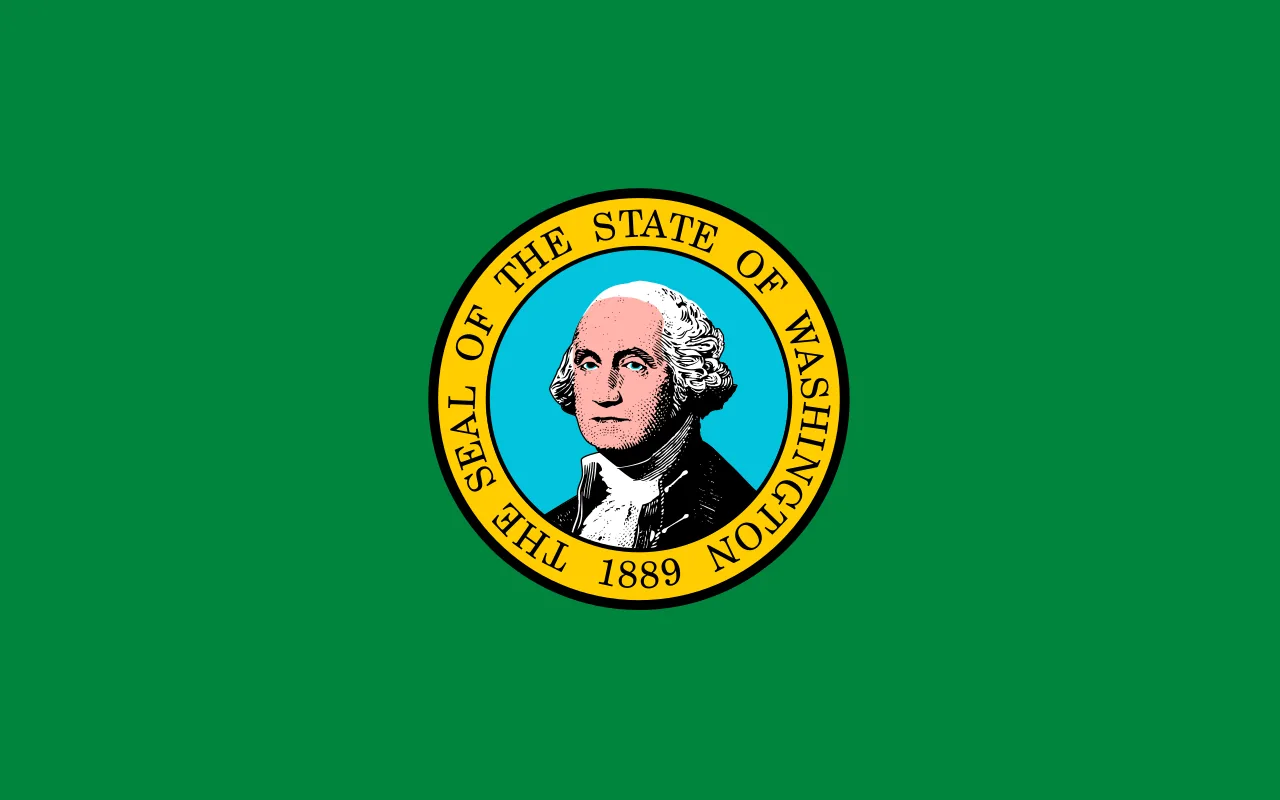
The Washington state flag. Image: Wikimedia Commons, public domain.
The short answer
- When is the final paycheck due in Washington? By the next regular payday. No same-day check required.
- Fired or quit? Same deadline.
- Unused vacation or PTO? A voluntary benefit. Your policy or agreement decides.
- Paperwork? No state form to hand over. But if a former employee asks in writing why they were fired, you owe a signed written answer within 21 calendar days.
Washington final paycheck law gives you until the regular payday, whether you fired the person or they quit. The deadline is the easy part. What catches owners is holding the check for unreturned gear, taking deductions the state doesn't allow, and missing the 21-day clock on a written request for the reason.
General education, not legal advice. For a specific situation, talk to a Washington employment attorney.
On this page
- When is the final paycheck due in Washington
- Do you have to pay out unused PTO
- What you can deduct from the last check
- If they ask in writing why they were fired
- What a late or short final paycheck costs you
- FAQ
- Sources
When is the final paycheck due in Washington
When an employee stops working for you, fired or quit, their wages are due at the end of the established pay period. The state Department of Labor & Industries (L&I) puts it in plain terms: the final paycheck is due on or before the next regularly scheduled payday.
There is no same-day rule and no separate rule for a firing.
A quick example
You pay every other Friday. You fire someone on a Tuesday in the middle of a pay period. Their wages for that period are due on the regular payday for that period.
You can't hold the check for keys or tools
L&I is direct: you cannot hold back a final paycheck because the employee hasn't returned keys, uniforms, tools or equipment.
Here is how I'd handle it:
- Pay final wages on time. Don't use the paycheck as leverage, and don't withhold legally owed wages.
- Document what's missing and send a written request with a reasonable return deadline.
- Keep a record of every attempt to get it back. If it still isn't returned, talk to an employment attorney about your civil options. Suspected theft may warrant a police report.
Union shops
If the employee worked under a union contract that sets a different pay date, the contract controls. Read it.
Do you have to pay out unused PTO
Vacation and PTO
L&I treats vacation time, personal holidays and severance as voluntary benefits. You can choose to pay them out on the final check. If an employee thinks they are owed a benefit you agreed to, L&I points them to an attorney or small claims court.
So the answer is in your own documents:
- Policy or agreement promises a payout: pay it.
- Policy says unused time is forfeited: follow it, the same way for everyone.
- No written policy: you are arguing over what was promised. Write one, and ask your attorney how a silent policy will be read.
Paid sick leave is a separate rule
Washington requires paid sick leave, and it has its own rule when the job ends:
- You generally do not have to pay out unused paid sick leave.
- If you rehire the person within 12 months, the unused balance comes back.
- Construction exception: construction employers must pay a construction worker the unused balance if the worker separates before reaching the 90th day of employment.
If you run one combined PTO bank that also covers sick leave, make your written policy say how the bank is treated at separation. L&I says a sick leave balance you pay out in full when the job ends doesn't have to be reinstated on rehire.
What you can deduct from the last check
Washington is strict here. You can't withhold from wages unless the deduction is required by law, specifically agreed to by the employee (orally or in writing), or for medical, surgical or hospital care and recorded in your books.
For a final paycheck, the state spells it out.
Allowed, and may take pay below minimum wage:
- Deductions required by state or federal law, such as court orders and child support.
- Benefit plan contributions agreed to in advance.
- Payments the employee agreed to in advance, such as the balance of a loan from you.
- Purchases from you under a written agreement.
- Wage advances or draws you recorded.
Allowed in the final pay period only, and may not take pay below minimum wage:
- A cash register shortage, if the employee had sole access and counted the till at the start and end of the shift.
- A bad check or credit card the employee accepted against your known procedures.
- Cash shortages, customer walkouts, breakage or lost equipment caused by the employee's dishonest or willful act.
- Theft, only if the employee intended to deprive you and you filed a police report.
Allowed if agreed to, but may not take pay below minimum wage:
- The cost of a uniform you provided that isn't returned at termination.
Not allowed:
- Breakage, shortages or losses that were accidents.
- Losses from earlier pay periods.
- Theft with no police report.
Three things to remember:
- You carry the burden of proving any agreement existed. L&I recommends written, signed agreements.
- Every deduction has to be recorded openly in your payroll records.
- These limits do not stop you from suing a former employee over a debt.
Small-business HR news, in plain words
New laws, pay rules and people problems that hit your business and your bottom line, explained in plain words. One short email when it matters.
It's free. Enter your email on the next page and you're on the list. We'll send it to your inbox. Unsubscribe any time.
If they ask in writing why they were fired
Washington has no separation form you must hand over at the door. It has a rule about what happens if the former employee asks.
Within 21 calendar days of a written request from a former employee or their designee, you must provide a signed written statement that gives:
- The effective date of the discharge.
- Whether you had a reason for the discharge.
- If so, the reasons.
A "former employee" here is someone who separated within three years of the request.
This is the current rule. The statute was amended in 2025, and the L&I regulation now also reads 21 calendar days. If your handbook or an old checklist says 10 working days, it is out of date.
The same clock applies to the personnel file
A current or former employee can ask for a copy of their personnel file. You have 21 calendar days to provide it, at no cost.
What missing the deadline costs
A former employee can sue to enforce these rights. They first have to give you a notice of intent to sue, and they can file five calendar days after that notice. The notice can come with the original request.
Statutory damages per violation:
- $250 if the file or statement is not provided within 21 calendar days.
- $500 if not provided within 28 calendar days.
- $1,000 if provided later than 35 calendar days.
- $500 for other violations.
Add reasonable attorney's fees and costs.
Why this matters before the meeting
Whatever reason you give in the termination meeting, expect to sign your name under it later. Decide the reason, write it down, and make sure it matches your records before you fire anyone.
Washington's rules also sit on top of federal laws like the FMLA, the ADA and Title VII. The reason you sign has to hold up under both.
What a late or short final paycheck costs you
There are two tracks.
An L&I wage complaint
When L&I finds a wage payment violation, it can issue a citation and notice of assessment.
- Interest: 1% per month on wages owed.
- Civil penalty for a willful violation: the legislature amended this section three times in 2026, and the versions don't match. One sets the floor at $1,500 or 10% of the unpaid wages, whichever is bigger, and drops the $20,000 cap. The other two keep $1,000 or 10%, capped at $20,000. Plan on the higher number.
- The way out: pay all wages and interest within 10 business days of receiving the citation. If you are not a repeat willful violator, the older versions require L&I to waive the penalty. The newer version makes the waiver L&I's choice, and only if you also haven't settled a wage complaint more than once in the past 12 months or three times in the past 24.
A lawsuit for willful withholding
Willfully paying an employee less than you owe, with intent to deprive them of it, is a misdemeanor. The employee can also sue for twice the wages withheld, plus costs and attorney's fees. Officers and agents of the business can be held liable, not just the company.
A $1,200 check held for two months to pressure someone into returning a laptop can become $2,400 plus fees.
FAQ
When is a final paycheck due in Washington?
At the end of the established pay period. L&I describes it as on or before the next regularly scheduled payday.
Does Washington require a final paycheck the same day you fire someone?
No. The deadline is the regular payday, for a firing or a resignation.
Does Washington require PTO payout when an employee leaves?
No. L&I treats vacation as a voluntary benefit, so your policy or agreement decides.
Do I have to pay out unused sick leave in Washington?
Generally no. If you rehire the person within 12 months, the unused balance comes back. Construction employers have an exception for workers who leave before their 90th day.
Can I hold a final paycheck until the employee returns company property?
No. Pay final wages on time — don't withhold legally owed wages. Document what's missing, send a written request with a reasonable return deadline, and keep a record of your attempts to recover it. If the property still isn't returned, consult an employment attorney about your civil recovery options. Suspected theft may warrant a police report.
Do I have to give a fired employee the reason in writing?
Only if they ask in writing. Then you have 21 calendar days to provide a signed statement with the discharge date and the reasons.
What is the penalty for a late final paycheck in Washington?
L&I can assess 1% monthly interest and a civil penalty for willful violations. An employee can also sue for twice the wages willfully withheld, plus attorney's fees.
Want to learn more about your state's laws? See Final Paycheck Laws by State.
Sources
- RCW 49.48.010 (payment of wages at separation; withholding). https://app.leg.wa.gov/RCW/default.aspx?cite=49.48.010
- Washington State Department of Labor & Industries, Getting Paid. https://www.lni.wa.gov/workers-rights/wages/getting-paid/
- WAC 296-126-025 (deductions from final wages). https://app.leg.wa.gov/wac/default.aspx?cite=296-126-025
- RCW 49.46.210(1)(k) and (1)(l) (paid sick leave at separation; reinstatement on rehire). https://app.leg.wa.gov/RCW/default.aspx?cite=49.46.210
- RCW 49.12.250 (personnel file copy; signed statement of discharge date and reasons; amended by 2025 c 273). https://app.leg.wa.gov/RCW/default.aspx?cite=49.12.250
- WAC 296-126-050 (personnel records; written statement of reasons for discharge). https://app.leg.wa.gov/wac/default.aspx?cite=296-126-050
- RCW 49.12.261 (private cause of action; notice of intent to sue; statutory damages). https://app.leg.wa.gov/RCW/default.aspx?cite=49.12.261
- RCW 49.48.083 (citation and notice of assessment; interest; civil penalty; three 2026 versions: 2026 c 53, c 77 and c 176). https://app.leg.wa.gov/RCW/default.aspx?cite=49.48.083
- RCW 49.52.050 (willful underpayment of wages; misdemeanor). https://app.leg.wa.gov/RCW/default.aspx?cite=49.52.050
- RCW 49.52.070 (civil liability for double damages). https://app.leg.wa.gov/RCW/default.aspx?cite=49.52.070
- Washington State Department of Labor & Industries, Paid Sick Leave. https://www.lni.wa.gov/workers-rights/leave/paid-sick-leave/
More for owners like you
Pay & laws
Final Paycheck Laws by State (2026)
When the last check is due, and what else you owe.

Firing
Before You Fire Someone: What to Think About First
Most bad firings go wrong months before the meeting.
Firing
When to Fire an Employee: What to Think About First
Most bad firings go wrong months before the meeting.
Small-business HR news, in plain words
New laws, pay rules and people problems that hit your business and your bottom line, explained in plain words. One short email when it matters.
It's free. Enter your email on the next page and you're on the list. We'll send it to your inbox. Unsubscribe any time.